Java Right Shift - >>>
- Understanding the Right Shift Operator
- Practical Applications of the Right Shift Operator
- Bit Manipulation and Performance
- Conclusion
- FAQ
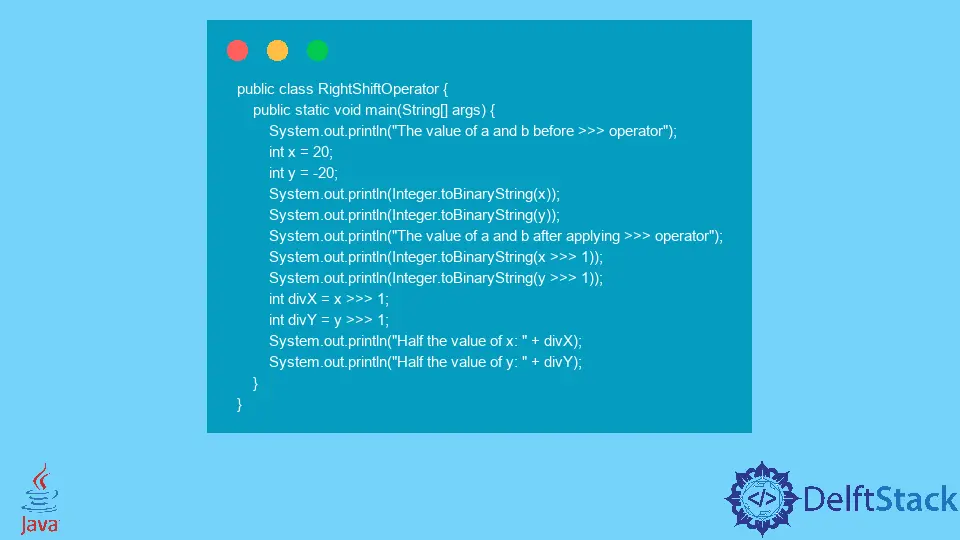
In the world of programming, understanding bitwise operations is crucial for optimizing performance and manipulating data at a low level. One such operation in Java is the right shift operator, denoted as »>. This operator is particularly useful when you need to shift the bits of a number to the right, filling the leftmost bits with zeros, regardless of whether the original number is positive or negative.
In this article, we will explore the right shift operator in Java, providing clear examples and explanations to help you grasp its functionality. Whether you’re a beginner looking to enhance your Java skills or an experienced developer wanting a quick refresher, this guide will equip you with the knowledge you need to effectively use the »> operator.
Understanding the Right Shift Operator
The right shift operator (»>) is a bitwise operator in Java that shifts the bits of a number to the right. When you apply this operator, the bits are moved to the right by a specified number of positions, and the leftmost bits are filled with zeros. This is particularly useful when working with unsigned integers, as it ensures that you do not encounter issues with negative numbers.
For instance, consider the number 8, which in binary is represented as 0000 1000. When you apply the right shift operator, the bits will be shifted to the right, and zeros will be introduced on the left side. This operation can be particularly handy when you want to perform arithmetic operations or manipulate binary data directly.
Example of Right Shift Operator
Here’s a simple example to illustrate how the right shift operator works in Java:
public class RightShiftExample {
    public static void main(String[] args) {
        int number = 8; // 0000 1000 in binary
        int result = number >>> 2; // Shift right by 2 positions
        System.out.println(result);
    }
}
The output of this code will be:
2
In this example, the number 8 is represented in binary as 0000 1000. When we apply the right shift operator with a shift of 2, the binary representation becomes 0000 0010, which is equivalent to the decimal number 2. This illustrates the basic functionality of the »> operator.
Practical Applications of the Right Shift Operator
The right shift operator is not only a theoretical concept; it has practical applications in various programming scenarios. For instance, it can be used in algorithms that require efficient data manipulation or in situations where you need to handle binary data, such as image processing or network programming.
One common use case is in encoding and decoding data. By shifting bits, you can easily isolate specific bits for processing or combine multiple values into a single integer. This is particularly useful in low-level programming, where performance and memory efficiency are paramount.
Example of Practical Application
Let’s look at a practical example where we might use the right shift operator to decode a value:
public class DecodeExample {
    public static void main(String[] args) {
        int encodedValue = 56; // Example encoded value
        int decodedValue = encodedValue >>> 3; // Shift right by 3 positions
        System.out.println(decodedValue);
    }
}
The output of this code will be:
7
In this example, the encoded value of 56 (which is 0011 1000 in binary) is decoded by shifting it right by three positions. The result is 7 (0000 0111 in binary). This demonstrates how the right shift operator can be utilized for decoding operations where data is packed into a single variable.
Bit Manipulation and Performance
When working with large datasets or performance-critical applications, using bitwise operations like the right shift operator can significantly enhance efficiency. Bit manipulation allows developers to perform complex calculations with minimal overhead, making it a preferred choice in high-performance applications.
Moreover, the right shift operator is often used in conjunction with other bitwise operators, such as AND (&), OR (|), and XOR (^), to achieve more complex operations. By combining these operators, you can create powerful algorithms for tasks like encryption, compression, and error detection.
Example of Bit Manipulation
Here’s an example demonstrating the combination of the right shift operator with other bitwise operations:
public class BitManipulationExample {
    public static void main(String[] args) {
        int value = 29; // 0001 1101 in binary
        int manipulatedValue = (value >>> 2) & 3; // Shift right by 2 and AND with 3
        System.out.println(manipulatedValue);
    }
}
The output of this code will be:
1
In this example, we first shift the value 29 (which is 0001 1101 in binary) right by 2 positions, resulting in 0000 1111. We then perform an AND operation with 3 (0000 0011), which gives us 0000 0001, or 1 in decimal. This showcases how the right shift operator can be effectively used in combination with other bitwise operations to achieve specific results.
Conclusion
The right shift operator (»>) in Java is a powerful tool for manipulating binary data and performing efficient calculations. By understanding how to use this operator, you can enhance your programming skills and tackle more complex problems with ease. Whether you’re decoding values, optimizing performance, or working with bitwise operations, the right shift operator is an essential part of your Java toolkit.
As you continue to explore Java and its capabilities, remember that mastering bitwise operations can open up new avenues for your programming journey. Practice using the right shift operator in different scenarios to fully grasp its potential and application.
FAQ
-
What is the difference between » and »> in Java?
The » operator shifts bits to the right while preserving the sign bit, whereas the »> operator shifts bits to the right and fills the leftmost bits with zeros, regardless of the sign. -
When should I use the right shift operator?
Use the right shift operator when you need to manipulate binary data, perform bitwise operations, or optimize performance in your Java applications. -
Can the right shift operator be used with negative numbers?
Yes, the right shift operator can be used with negative numbers, but it will fill the leftmost bits with zeros, which may lead to unexpected results if you’re not careful. -
How does the right shift operator affect performance?
Bitwise operations, including the right shift operator, are generally faster than arithmetic operations, making them ideal for performance-critical applications. -
Is there a limit to how many positions I can shift?
Yes, shifting by a number of positions greater than or equal to the number of bits in the data type will result in zero. For example, shifting a 32-bit integer by 32 or more positions will yield zero.

Rashmi is a professional Software Developer with hands on over varied tech stack. She has been working on Java, Springboot, Microservices, Typescript, MySQL, Graphql and more. She loves to spread knowledge via her writings. She is keen taking up new things and adopt in her career.
LinkedIn