HOWTO · JavaScript
How to Get Width of Element in JavaScript
This article shows how to extract the proper width or height of an element using HTML DOM properties and specific methods in JavaScript. Learn about offsetWidth, clientWidth, and getBoundingClientRect to effectively measure elements for responsive web design.
When working with web development, understanding how to manipulate and measure elements on a page is crucial. One common requirement is to determine the width of an HTML element using JavaScript. Whether you’re designing a responsive layout or creating dynamic content, being able to extract the proper width or height of an element can significantly enhance your web applications. In this article, we will explore various methods to achieve this using the HTML DOM properties and specific JavaScript methods.
From using the offsetWidth property to the more precise getBoundingClientRect() method, this guide will provide you with the tools you need to accurately measure elements on your webpage. By the end of this article, you’ll have a solid understanding of how to get the width of an element in JavaScript, enabling you to create more dynamic and responsive designs.
Using offsetWidth Property
The offsetWidth property is one of the simplest ways to get the width of an element. It returns the layout width of an element, including padding, borders, and vertical scrollbars (if present). However, it does not include margins. This property is particularly useful when you need a quick measurement of an element’s width.
Here’s how you can use offsetWidth:
<!DOCTYPE html>
<html>
<head>
  <meta charset="utf-8">
  <meta name="viewport" content="width=device-width">
  <title>Test</title>
</head>
<body>
<div id="foo" style="background-color: purple; height:125px; width:125px">
</div>
</body>
</html>
var height = document.getElementById('foo').offsetHeight;
var width = document.getElementById('foo').offsetWidth;
console.log(height);
console.log(width);
Output:
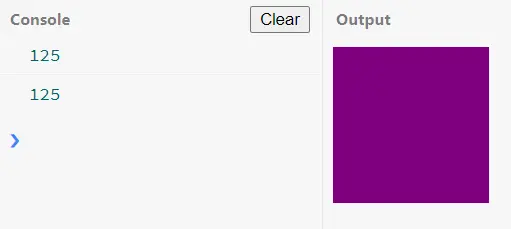
In this example, we first select an element with the ID myElement. The offsetWidth property is then used to retrieve its width, which is logged to the console. This method is straightforward and works well for most scenarios. However, keep in mind that offsetWidth returns a value in pixels, and it can be affected by the CSS styles applied to the element, such as padding and borders.
Using clientWidth Property
Another effective way to measure the width of an element is by using the clientWidth property. This property returns the inner width of an element, which includes padding but excludes borders, margins, and scrollbars. It’s particularly useful when you want to get the available space inside an element.
Here’s how to implement clientWidth:
const element = document.getElementById('myElement');
const width = element.clientWidth;

console.log(width);
Output:
280
In this case, the clientWidth property retrieves the width of the myElement element, taking into account only the padding. This can be particularly helpful when you are interested in the space available for content within an element, as it excludes borders and margins that might otherwise skew your measurements. If you are working with layouts that require precise content positioning, clientWidth is a great tool to have in your arsenal.
Using getBoundingClientRect Method
The getBoundingClientRect() method is a more advanced and precise way to get the dimensions of an element. This method returns a DOMRect object that contains information about the size of an element and its position relative to the viewport. This includes the width, height, and coordinates of the element, making it a comprehensive option for measuring elements.
Here’s how you can use getBoundingClientRect():
<!DOCTYPE html>
<html>
<head>
  <meta charset="utf-8">
  <meta name="viewport" content="width=device-width">
  <title>Test</title>
</head>
<body>
<div id="foo" style="background-color: black; height:125px; width:125px">
</div>
</body>
</html>
var element = document.getElementById('foo');
var positionInfo = element.getBoundingClientRect();
var height = positionInfo.height;
var width = positionInfo.width;
console.log(height);
console.log(width);
console.log(document.getElementById('foo').getBoundingClientRect());
Output:
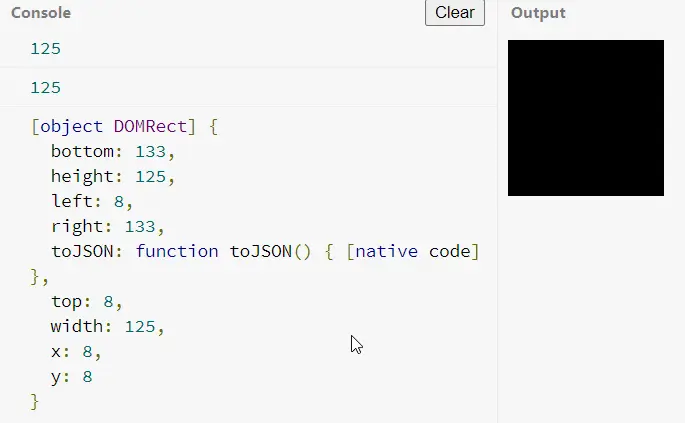
In this example, we call getBoundingClientRect() on foo, which returns a DOMRect object. This method is particularly useful when dealing with elements that may be transformed by CSS (like scaling or rotation), as it provides accurate measurements regardless of how the element is displayed. If you are developing complex layouts or animations, leveraging getBoundingClientRect() can help ensure that your measurements are accurate.
Conclusion
Measuring the width of an HTML element in JavaScript is a fundamental skill for any web developer. Whether you choose to use offsetWidth, clientWidth, or getBoundingClientRect(), each method has its own advantages depending on your specific needs. By mastering these techniques, you can create more responsive and dynamic web applications that adapt to various screen sizes and layouts. Remember to consider the context in which you’re measuring, and choose the method that best fits your requirements.
FAQ
-
How do I get the width of an element in JavaScript?
You can use properties likeoffsetWidth,clientWidth, or thegetBoundingClientRect()method to get the width of an element in JavaScript. -
What is the difference between offsetWidth and clientWidth?
offsetWidthincludes padding, borders, and scrollbars, whileclientWidthincludes only the padding and excludes borders and scrollbars. -
When should I use getBoundingClientRect()?
UsegetBoundingClientRect()when you need precise measurements of an element, especially when dealing with transformations or positioning relative to the viewport. -
Can I get the width of an element that is not visible?
Yes, you can still retrieve the width of an element that is not visible using these methods, but the values may not reflect the actual layout when the element is hidden. -
Does the width include margins?
No, none of these properties include margins. If you need to account for margins, you will need to calculate them separately.