HOWTO · Java
Fix “Unable to Install Java. There Are Errors in the Following Switches” on Windows
Learn why Windows shows this misleading Java launcher error when opening a JAR file and how to repair the file association, test the JAR, and reinstall Java only when necessary.
On this page
If Windows shows Unable to install Java. There are errors in the following switches while you open a .jar file, Java is often already installed. The message usually means that Windows passed the file to the wrong launcher or that the .jar file association is damaged. Repair the association first; reinstall Java only if the launcher is missing or cannot run.
Understand the error before changing Java
The wording is misleading because it says that Java installation was not completed. A typical dialog includes the selected file path, such as C:\Users\Admin\Desktop\filename.jar, and asks you to check the commands. That path is being treated as a command-line switch by an installer-style launcher instead of being opened as a JAR.
The most common causes are a changed .jar file association, more than one Java installation leaving Windows with an unexpected launcher, or a download that is not actually a JAR. A corrupt JAR can also fail after the association is repaired. Therefore, do not delete every Java installation immediately: first confirm what you downloaded and which launcher Windows is using.
Confirm the download and Java installation
- In File Explorer, enable file-name extensions and confirm that the file really ends in
.jar. A ZIP, RAR, or installer renamed with a.jarsuffix is not a runnable JAR. - Check that the download came from a source you trust. If the file size is suspicious or the download page supplies a checksum, download it again and compare the checksum.
- Open Settings > Apps > Installed apps and check whether a compatible Java installation is present. From Command Prompt,
java -versionis another quick check. If Windows reports thatjavais not recognized, repair or install Java before troubleshooting the file association.
Set the .jar file association to javaw.exe
Windows supports changing default programs by file type. The labels vary slightly between Windows 10 and Windows 11, but the association should point to the installed Java launcher, not to a Java installer.
-
Right-click the
.jar file, choose Open with > Choose another app, and expand More apps if necessary.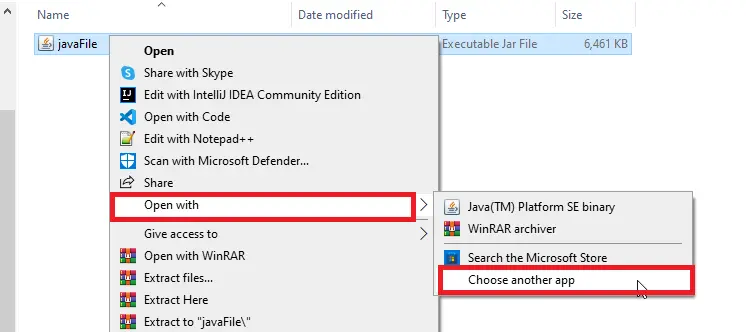
-
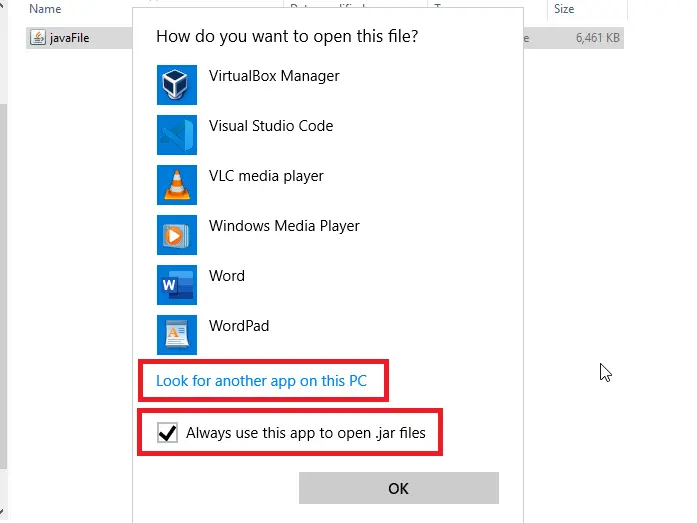
Select Look for another app on this PC. If the dialog offers Always use this app to open .jar files, select it only after you have chosen the correct launcher.
-
Browse to the
bindirectory of the Java installation and selectjavaw.exe. Do not guess a historicaljreVersionfolder: installed paths differ by Java distribution and release. If you cannot findjavaw.exe, use the Java installation’s documented location or reinstall a compatible current JDK from Oracle’s Java downloads.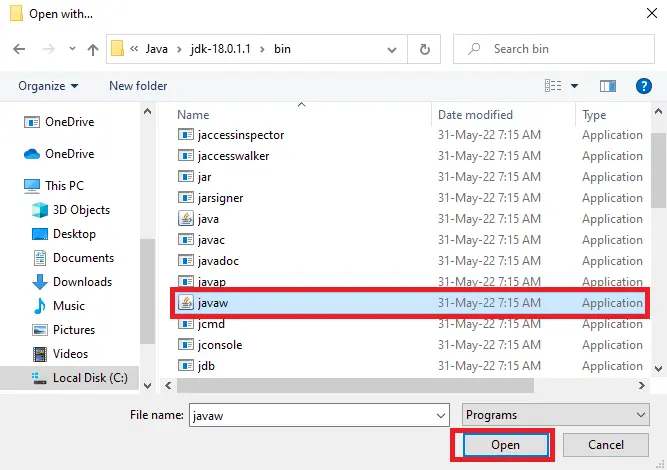
-
Try the file again. If it opens, the problem was the Windows Default apps association. If the same dialog returns, continue with the command-line test below so that Windows shows a more useful diagnostic.
Test the JAR from Command Prompt
Open Command Prompt, change to the folder containing the download, and run java -jar "C:\Users\you\Downloads\game.jar". A valid executable JAR should start or print its own application output. This is a second, independent launch path because it uses java directly instead of the Explorer association.
For a boundary check, run the same command against a file that is actually a ZIP, for example java -jar "C:\Users\you\Downloads\game.zip". An error such as an inaccessible or invalid JAR indicates a wrong file, a damaged download, or a non-executable archive; it does not prove that reinstalling Java will fix the problem. Replace the path with the real file name and quote it when the path contains spaces.
Reinstall Java only when the launcher is missing or broken
Reinstalling is appropriate when java -version fails, javaw.exe is absent from a known installation, or a fresh trusted JAR still fails after the association is repaired. In Settings > Apps > Installed apps, remove obsolete or damaged Java installations that you no longer need, then download a current, compatible JDK from the official Oracle download page. Choose the installer that matches your Windows architecture and the application’s compatibility requirements; do not treat old x32/x64 wording as a universal Java version choice.
After installation, repeat java -version, set the .jar file default app to the new javaw.exe, and test the JAR again. A third-party utility such as Jarfix.exe can repair an association, but it changes Windows file-association settings. Prefer the built-in Default apps controls, and use a third-party tool only when you trust its source and understand that it does not repair a corrupt JAR or install Java.