How to Break Out of a Loop in Bash
-
Using the
breakCommand -
Using the
exitCommand -
Using a Conditional Statement with
break - Nested Loops and Breaking Out
- Conclusion
- FAQ
When working with Bash scripts, loops are a powerful feature that allows you to execute a block of code multiple times. However, there may come a time when you need to exit a loop prematurely. Whether you’re processing files, handling user input, or managing tasks, knowing how to break out of a loop is essential for effective scripting. In this tutorial, we’ll explore various methods to break out of loops in Bash, ensuring you have the tools you need to control your script’s flow efficiently.
Understanding how to break out of a loop can save you time and prevent unnecessary processing. By mastering these techniques, you’ll enhance your Bash scripting skills and streamline your workflow. Let’s dive into the different methods available for breaking out of loops in Bash, complete with clear examples and explanations.
Using the break Command
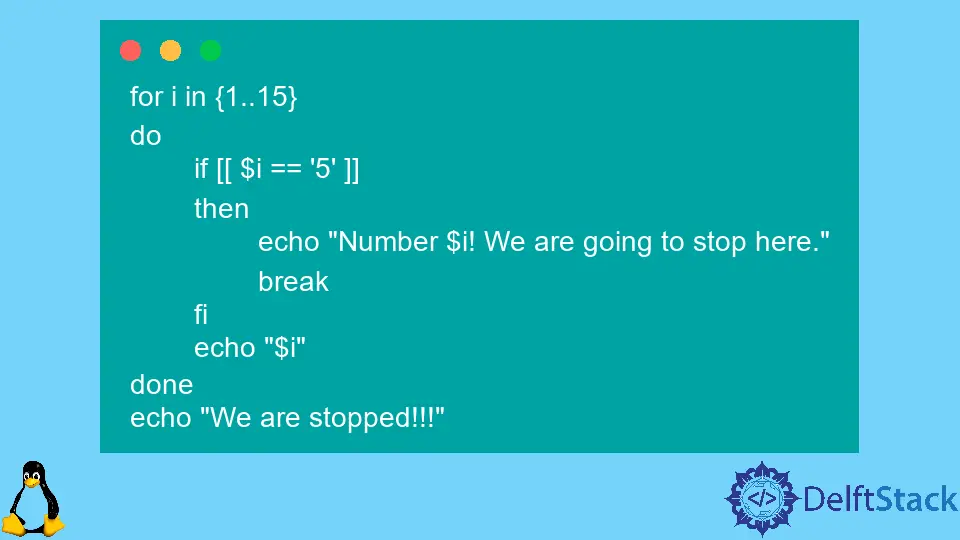
The simplest way to exit a loop in Bash is by using the break command. This command allows you to terminate the loop immediately when a certain condition is met. The break command can be used within for, while, and until loops.
Here’s an example of using the break command in a for loop:
for i in {1..10}; do
    if [ $i -eq 5 ]; then
        break
    fi
    echo "Current number: $i"
done
In this code snippet, we loop through the numbers 1 to 10. When the loop variable i reaches 5, the break command is executed. This effectively exits the loop, and the script will stop printing numbers after 4. The output would be:
Current number: 1
Current number: 2
Current number: 3
Current number: 4
The break command is particularly useful when you’re searching for a specific condition and want to stop processing further once it’s found. This not only makes your script more efficient but also reduces unnecessary computations.
Using the exit Command
In some cases, you might want to exit not just from the loop but from the entire script. The exit command can be used for this purpose. By using exit, you can terminate the script at any point, including from within a loop.
Here’s an example that demonstrates the use of the exit command:
for i in {1..10}; do
    if [ $i -eq 5 ]; then
        echo "Exiting the script."
        exit
    fi
    echo "Current number: $i"
done
When the loop variable i equals 5, the message “Exiting the script.” will be printed, and the script will terminate immediately. The output will be:
Current number: 1
Current number: 2
Current number: 3
Current number: 4
Exiting the script.
Using exit is a powerful way to stop everything, especially when an error occurs or the desired condition is met, ensuring that no further code is executed after that point.
Using a Conditional Statement with break
Sometimes, you may want to break out of a loop based on more complex conditions. By combining conditional statements with the break command, you can create more sophisticated exit strategies.
Here’s an example using a while loop with a conditional statement:
count=1
while [ $count -le 10 ]; do
    if [ $count -eq 7 ]; then
        echo "Breaking out of the loop at count $count."
        break
    fi
    echo "Count is: $count"
    ((count++))
done
In this example, the loop continues until the count variable exceeds 10. However, when count equals 7, the loop breaks. The output will be:
Count is: 1
Count is: 2
Count is: 3
Count is: 4
Count is: 5
Count is: 6
Breaking out of the loop at count 7.
This method is particularly useful when you need to evaluate multiple conditions before deciding to break out of the loop. It allows for greater flexibility in your scripting logic.
Nested Loops and Breaking Out
When dealing with nested loops, the break command can also be used to exit from an outer loop. This is done by specifying a numeric argument with the break command, indicating how many levels of loops to break out of.
Here’s an example of breaking out of a nested loop:
for i in {1..3}; do
    for j in {1..3}; do
        if [ $i -eq 2 ] && [ $j -eq 2 ]; then
            break 2
        fi
        echo "i: $i, j: $j"
    done
done
In this case, when both i and j equal 2, the command break 2 is executed, which breaks out of both loops. The output will be:
i: 1, j: 1
i: 1, j: 2
i: 1, j: 3
i: 2, j: 1
i: 2, j: 2
This technique is beneficial when you have multiple layers of loops and want to exit all of them based on a specific condition. It allows you to manage complex logic effectively.
Conclusion
Breaking out of loops in Bash is a fundamental skill that enhances your scripting capabilities. Whether you use the break or exit command, or combine them with conditional statements, understanding these techniques will help you control the flow of your scripts better. By mastering these methods, you’ll be able to write more efficient and effective Bash scripts, ultimately saving time and resources in your projects.
As you continue to explore the world of Bash scripting, remember that practice is key. Experiment with these techniques in your scripts, and soon you’ll find yourself breaking out of loops with confidence.
FAQ
-
How do I break out of a loop in Bash?
You can use thebreakcommand to exit a loop in Bash when a certain condition is met. -
Can I exit a script from within a loop?
Yes, you can use theexitcommand to terminate the entire script from within a loop. -
What is the difference between
breakandexit?
Thebreakcommand exits only the loop, while theexitcommand terminates the entire script. -
How do I break out of nested loops in Bash?
You can usebreakwith a numeric argument to specify how many levels of loops to break out of. -
Can I use conditions to control when to break out of a loop?
Yes, combining conditional statements with thebreakcommand allows for more complex exit strategies.

Aminul Is an Expert Technical Writer and Full-Stack Developer. He has hands-on working experience on numerous Developer Platforms and SAAS startups. He is highly skilled in numerous Programming languages and Frameworks. He can write professional technical articles like Reviews, Programming, Documentation, SOP, User manual, Whitepaper, etc.
LinkedIn