How to Convert Strings to Lower Case in R
- Using the tolower() Function
- Using the stringr Package
- Using the tolower() Function with Data Frames
- Conclusion
- FAQ
When working with data in R, you may often find yourself needing to manipulate strings. One common operation is converting strings to lower case. This can be particularly useful when you want to standardize text data for analysis or comparison. Whether you’re cleaning up user input or preparing data for machine learning, converting strings to lower case is a fundamental skill every R programmer should master.
In this tutorial, we will explore various methods to convert strings to lower case in R. We’ll cover built-in functions and some handy packages that can make this task easier. By the end of this article, you’ll have a solid understanding of how to handle string manipulation in R, ensuring your data is clean and ready for analysis.
Using the tolower() Function
One of the simplest ways to convert strings to lower case in R is by using the built-in tolower() function. This function takes a character vector as input and returns the same vector with all characters converted to lower case.
Here’s how you can use tolower():
# Sample string
text <- "Hello, World!"

# Convert to lower case
lower_case_text <- tolower(text)

lower_case_text
Output:
hello, world!
The tolower() function is straightforward and efficient. It works with both single strings and vectors of strings, making it versatile for various applications. When you pass a string to tolower(), it processes each character and converts any uppercase letters to their lowercase equivalents. This is particularly useful when you’re working with text data from different sources, as it helps eliminate case sensitivity issues.
Using the stringr Package
The stringr package is a powerful tool for string manipulation in R. It provides a consistent and easy-to-use set of functions for string operations. To convert strings to lower case using stringr, you can use the str_to_lower() function.
First, you need to install and load the stringr package if you haven’t done so already:
# Install stringr package
install.packages("stringr")

# Load stringr package
library(stringr)

# Sample string
text <- "Hello, World!"

# Convert to lower case
lower_case_text <- str_to_lower(text)

lower_case_text
Output:
hello, world!
The str_to_lower() function works similarly to tolower(), but it comes with the added benefit of being part of a larger suite of string manipulation functions. This can be particularly advantageous when you need to perform multiple string operations in a single workflow. The stringr package is designed to be user-friendly and is particularly popular among data scientists and statisticians for its intuitive syntax and functionality.
Using the tolower() Function with Data Frames
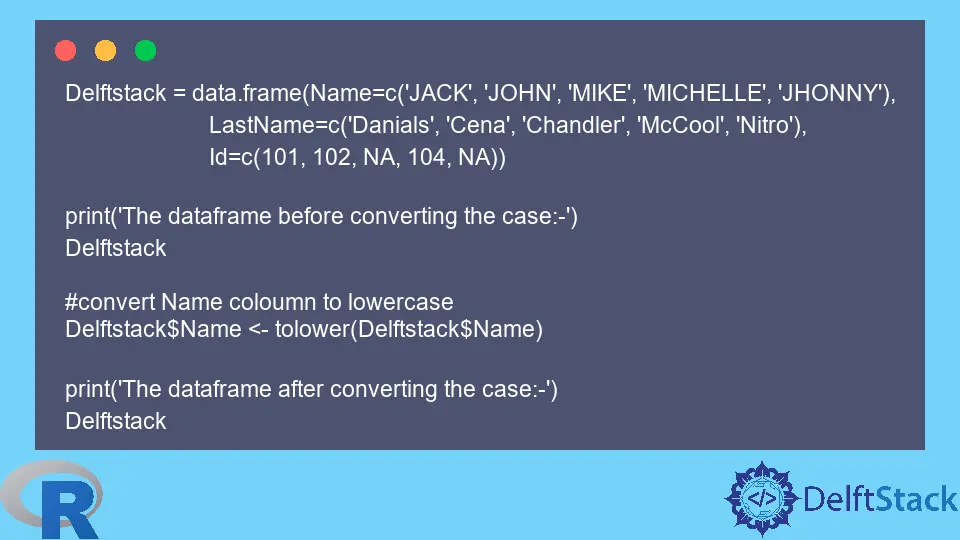
When dealing with data frames in R, you might want to convert entire columns of text to lower case. The tolower() function can still be utilized, but it requires a slightly different approach. You can use the mutate() function from the dplyr package to apply tolower() to a specific column.
Here’s how you can do this:
# Load necessary packages
library(dplyr)

# Sample data frame
df <- data.frame(Name = c("Alice", "Bob", "CHARLIE"))

# Convert Name column to lower case
df <- df %>%
  mutate(Name = tolower(Name))

df
Output:
    Name
1  alice
2    bob
3 charlie
In this example, we created a data frame with a column of names. By using the mutate() function in combination with tolower(), we transformed the entire “Name” column to lower case. This approach is particularly useful when working with larger datasets, as it allows you to efficiently clean and standardize text data across multiple entries. The dplyr package is a staple in R for data manipulation and provides a range of powerful functions for data wrangling.
Conclusion
Converting strings to lower case in R is an essential skill for anyone working with text data. Whether you choose to use the built-in tolower() function, the stringr package, or a combination of dplyr and tolower(), each method offers its own advantages. By mastering these techniques, you can ensure your data is clean, standardized, and ready for analysis. Remember that text manipulation is a critical part of data preparation, and these tools will serve you well in your R programming journey.
FAQ
-
What is the purpose of converting strings to lower case in R?
Converting strings to lower case helps standardize text data, making it easier to compare and analyze without case sensitivity issues. -
Can I convert multiple strings to lower case at once?
Yes, both thetolower()function and thestr_to_lower()function can handle vectors of strings, converting all of them to lower case simultaneously. -
Is the
stringrpackage necessary for string manipulation in R?
While it’s not necessary, thestringrpackage offers a more consistent and user-friendly approach to string manipulation, making it a popular choice among R users. -
How can I apply lower case conversion to a specific column in a data frame?
You can use themutate()function from thedplyrpackage in combination withtolower()to convert a specific column to lower case. -
Are there any other string manipulation functions I should know about in R?
Yes, R has a variety of string manipulation functions, includingtoupper()for converting to upper case,substr()for extracting substrings, and functions from thestringrpackage for more complex operations.

Sheeraz is a Doctorate fellow in Computer Science at Northwestern Polytechnical University, Xian, China. He has 7 years of Software Development experience in AI, Web, Database, and Desktop technologies. He writes tutorials in Java, PHP, Python, GoLang, R, etc., to help beginners learn the field of Computer Science.
LinkedIn Facebook