HOWTO · Csharp
How to Connect to an Access Database in C#
We will learn how to connect to an Access database in C# in this article.
This article will discuss connecting to an Access database in C#.
Microsoft Access
Microsoft Access is a data management program that allows you to save data for future reference, reporting, and analysis. Unlike Microsoft Excel or other spreadsheet tools, Microsoft Access enables you to analyze vast volumes of data and efficiently handle related data.
Connect to an Access Database in C#
We can connect to an Access database in C# by following the steps below.
-
First, open Microsoft Access and select a Blank Desktop Database. Name the database, and then click Create.
-
Create a table in the database, and name it. We’ll call it
EmployeeInfo, with four columns:Eid,Ename,Edept, andEaddress. -
Now, launch Microsoft Visual Studio and create a new Windows Form Application. In Solution Explorer, drag and drop the database file from Documents to the Project Directory folder generated using Microsoft Access.
-
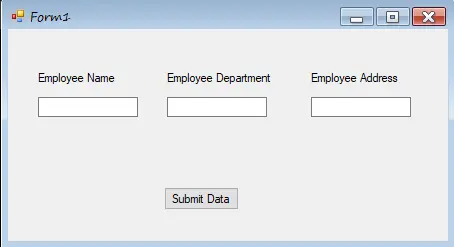
Create a form design like the following:
-
Double click on the
Submit DataButton, When you double-click the1button, an event will be created. -
Now, add the following libraries for connectivity:
using System; using System.Collections.Generic; using System.ComponentModel; using System.Data; using System.Drawing; using System.Linq; using System.Text; using System.Windows.Forms; using System.Data.OleDb; -
Generate a connection string by going to the
Toolsand selectingConnect to the databasefrom the list, then browse the database from the Project Directory.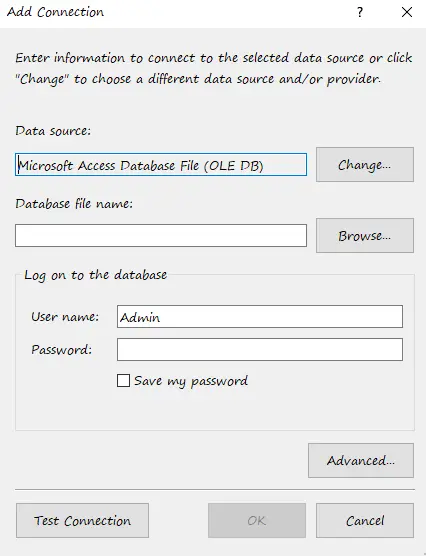
-
Select
Advancedand thenProviderfrom the list. Copy the text as your connection string. -
Now, create a connection string and assign it to a static string typed variable
constrlike the following:static string constr = "Provider=Microsoft.Jet.OLEDB.4.0;Data Source= " + Application.StartupPath + "/employeeinfo.mdb"; -
Initialize an
OleDbConnectiontype variabledbconto make a connection and pass connection stringconstras a parameter:OleDbConnection dbcon = new OleDbConnection(constr); -
Finally, add these lines of code to input employee information such as employee name, department, and address.
OleDbCommand cmd = dbcon.CreateCommand(); dbcon.Open(); cmd.CommandText = "Insert into EmployeeInfo (Ename, Edept,Eaddress)Values('" + txtEmpname.Text + "','" + txtEmpdept.Text + "','" + txtEmpaddress.Text + "')"; cmd.Connection = dbcon; cmd.ExecuteNonQuery(); MessageBox.Show("Data Inserted Successfully"); dbcon.Close();
Example Source Code
using System;
using System.Collections.Generic;
using System.ComponentModel;
using System.Data;
using System.Drawing;
using System.Linq;
using System.Text;
using System.Windows.Forms;
using System.Data.OleDb;
namespace WindowsFormsApplication1 {
public partial class Form1 : Form {
static string constr = "Provider=Microsoft.Jet.OLEDB.4.0;Data Source= " + Application.StartupPath +
                       "/employeeinfo.mdb";
OleDbConnection dbcon = new OleDbConnection(constr);
public Form1() {
InitializeComponent();
}
private void button1_Click_1(object sender, EventArgs e) {
OleDbCommand cmd = dbcon.CreateCommand();
dbcon.Open();
cmd.CommandText = "Insert into EmployeeInfo (Ename, Edept,Eaddress.)Values('" +
txtEmpname.Text + "','" + txtEmpdept.Text + "','" + txtEmpaddress.Text +
"')";
cmd.Connection = dbcon;
cmd.ExecuteNonQuery();
MessageBox.Show("Data Inserted", "Congrats");
dbcon.Close();
}
}
}