How to Find a Type of an Object in Go
Data types specify the type associated with a valid Go variable. There are four categories of datatypes in Go which are as follows:
- Basic type: Numbers, strings, and booleans
-
Aggregate type: Array and structs
-
Reference type: Pointers, slices, maps, functions, and channels
-
Interface type
We can find the data type of an object in Go using string formatting, reflect package, and type assertions.
String Formatting to Find Data Type in Go
We can use the Printf function of package fmt with a special formatting option. The available formatting options to display variables using fmt are:
| Format | Description |
|---|---|
%v |
Print the variable value in a default format |
%+v |
Add field names with the value |
%#v |
a Go-syntax representation of the value |
%T |
a Go-syntax representation of the type of the value |
%% |
a literal percent sign; consumes no value |
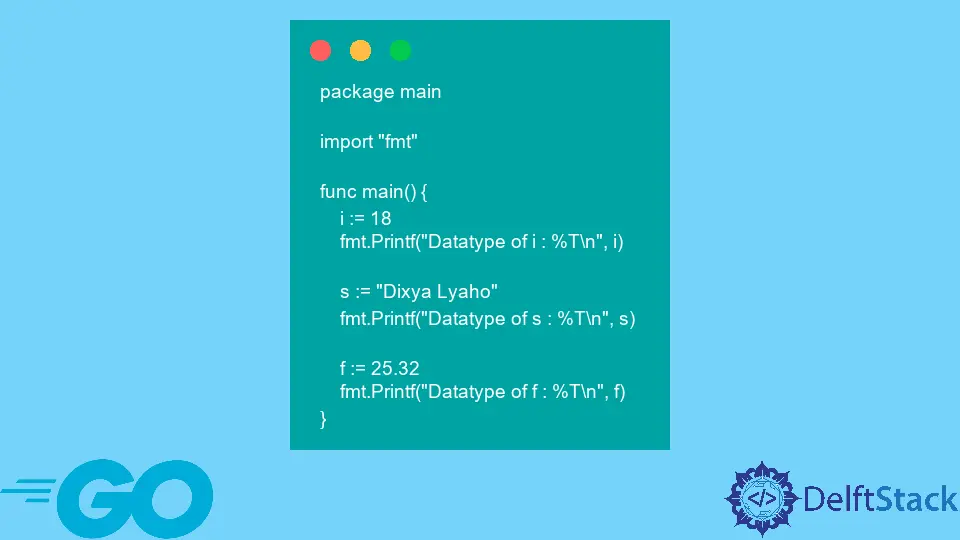
We use the %T flag in the fmt package to find a type of an object in Go.
package main

import "fmt"

func main() {
	i := 18
	fmt.Printf("Datatype of i : %T\n", i)

	s := "Dixya Lyaho"
	fmt.Printf("Datatype of s : %T\n", s)

	f := 25.32
	fmt.Printf("Datatype of f : %T\n", f)
}
Output:
Datatype of i : int
Datatype of s : string
Datatype of f : float64
reflect Package
We can also use the reflect package to find datatype of an object. The Typeof function of reflect package returns a data type that could be converted to a string with .String().
package main

import (
	"fmt"
	"reflect"
)

func main() {
	o1 := "string"
	o2 := 10
	o3 := 1.2
	o4 := true
	o5 := []string{"foo", "bar", "baz"}
	o6 := map[string]int{"apple": 23, "tomato": 13}

	fmt.Println(reflect.TypeOf(o1).String())
	fmt.Println(reflect.TypeOf(o2).String())
	fmt.Println(reflect.TypeOf(o3).String())
	fmt.Println(reflect.TypeOf(o4).String())
	fmt.Println(reflect.TypeOf(o5).String())
	fmt.Println(reflect.TypeOf(o6).String())

}
Output:
string
int
float64
bool
[]string
map[string]int
type assertions Method
Type assertion method returns a boolean variable to tell whether assertion operation succeeds or not. We use a type switch to do several type assertions in series to find the data type of the object.
package main

import (
	"fmt"
)

func main() {
	var x interface{} = 3.85
	switch x.(type) {
	case int:
		fmt.Println("x is of type int")
	case float64:
		fmt.Println("x is of type float64")
	default:
		fmt.Println("x is niether int nor float")

	}

}
Output:
x is of type float64

Suraj Joshi is a backend software engineer at Matrice.ai.
LinkedIn