How to Parse JSON in Bash
-
Use
jq(Lightweight, Flexible Command-Line JSON Processing Tool) to Parse JSON in Bash -
Use
grepto Parse JSON in Bash -
Use
python3to Parse JSON - Conclusion
- FAQ
Parsing JSON data in Bash can seem daunting, especially if you’re accustomed to higher-level programming languages. However, with the right tools and commands, you can efficiently handle JSON data directly from your terminal. This article will guide you through various methods of parsing JSON in Bash, leveraging tools that integrate seamlessly with Git workflows. Whether you’re extracting specific information from a JSON file or handling output from a Git command, mastering JSON parsing in Bash can significantly enhance your scripting capabilities.
In the realm of software development, JSON (JavaScript Object Notation) is a widely used format for data interchange. When working with Git, you often encounter JSON output, especially when using APIs or tools that return data in this format. Understanding how to parse this data effectively can streamline your workflow and enable you to automate tasks more efficiently. Let’s dive into the methods available for parsing JSON in Bash.
Use jq (Lightweight, Flexible Command-Line JSON Processing Tool) to Parse JSON in Bash
jq is a small cross-platform solution for managing JSON data in a shorter, simpler, and effortless way.
You can download jq from here.
Get Prettier Formatted JSON Data Using jq
jq . command prettifies the json data.
curl "https://jsonplaceholder.typicode.com/posts" | jq .
Output:
[
    {
      "userId": 1,
      "id": 1,
      "title": "delectus aut autem",
      "completed": false
    },
    {
      "userId": 1,
      "id": 2,
      "title": "quis ut nam facilis et officia qui",
      "completed": false
    },
    {
      "userId": 1,
      "id": 3,
      "title": "fugiat veniam minus",
      "completed": false
    }
    ... // remaining list of data
]
Get Specific Field’s Values From JSON
We can get values of any specific field from the array of JSON data using jq.[].field_name.
curl "https://jsonplaceholder.typicode.com/posts" | jq '.[].id'
Output:
1
2
3
...
Get the Title of the First Item From JSON
curl "https://jsonplaceholder.typicode.com/posts" | jq '.[0].title'
Output:
"delectus aut autem"
Use grep to Parse JSON in Bash
grep command can also be used for parsing JSON data.
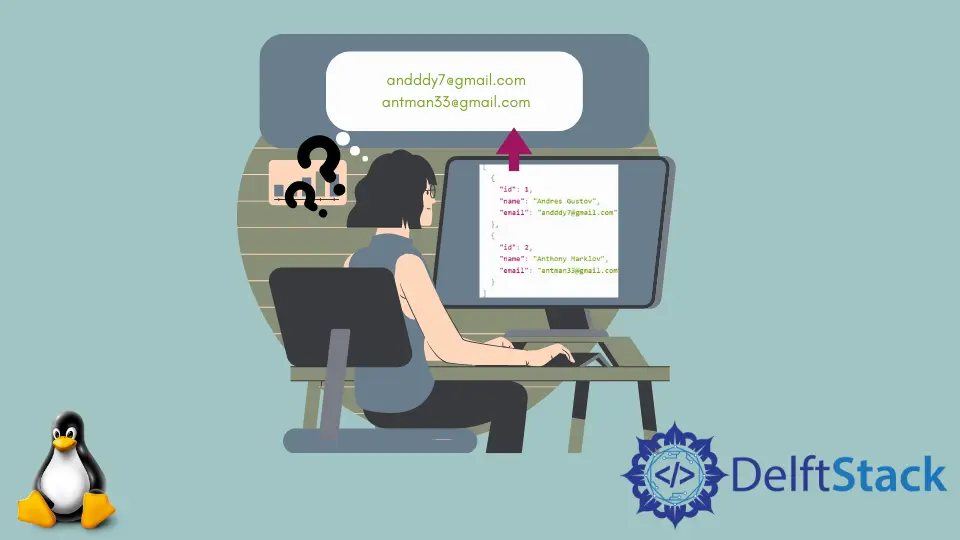
Example JSON file:
[
  {
    "id": 1,
    "name": "Andres Gustov",
    "email": "andddy7@gmail.com"
  },
  {
    "id": 2,
    "name": "Anthony Marklov",
    "email": "antman33@gmail.com"
  }
]
Example script:
grep -o '"email": "[^"]*' examplejsonfile.json | grep -o '[^"]*$'
We use the -o option to select only lines that match the given pattern. Then, we specify the pattern '"email": "[^"]*', which means we want all of the values of the key email. Following that, we pass the JSON file to look for the pattern. Finally, we pipe out the result with another grep -o command to remove everything except the value.
Output:
andddy7@gmail.com
antman33@gmail.com
Use python3 to Parse JSON
We can also use the json module of python to handle JSON operations.
curl -s 'https://jsonplaceholder.typicode.com/posts' | \
    python3 -c "import sys, json; print(json.load(sys.stdin))"
Get Specific Field Value
curl "https://jsonplaceholder.typicode.com/posts" | \
    python3 -c "import sys, json; data=json.load(sys.stdin); print([d['id'] for d in data])"
Output:
1
2
3
...
Get the Title of the First Item
curl "https://jsonplaceholder.typicode.com/posts" | \
    python3 -c "import sys, json; print(json.load(sys.stdin)[0]['title'])"
Output:
"delectus aut autem"
Conclusion
Parsing JSON in Bash is a valuable skill that can enhance your productivity, especially when working with Git and APIs. Whether you choose to use jq for its powerful querying capabilities, a combination of grep and sed for quick tasks, or Python for more complex scenarios, understanding these methods will empower you to handle JSON data effectively. As you become more comfortable with these tools, you’ll find that your ability to automate and streamline workflows will improve significantly.
FAQ
-
What is JSON?
JSON stands for JavaScript Object Notation, a lightweight data interchange format that is easy for humans to read and write and easy for machines to parse and generate. -
Why should I use jq for parsing JSON?
jq is a powerful tool specifically designed for working with JSON data. It offers advanced querying capabilities, making it easier to extract and manipulate data compared to simpler tools like grep and sed. -
Can I parse JSON without installing additional tools?
Yes, you can use a combination of grep and sed to parse simple JSON data directly in Bash without additional installations. -
Is Python necessary for parsing JSON in Bash?
While not necessary, using Python can simplify the process, especially for complex JSON structures. Python’s built-in JSON library provides robust parsing capabilities that can handle nested objects and arrays. -
How can I handle JSON files in Bash?
You can use tools like jq to read and parse JSON files directly in Bash. Alternatively, you can use Python to read JSON data from files and extract the necessary information.