HOWTO · Git
Difference Between Git Push Origin and Git Push Origin Master
This article outlines the differences between the git push origin and git push origin master commands, providing clarity on their uses in version control. Learn how to effectively manage your Git repository by understanding these essential commands. Enhance your workflow and collaboration with this comprehensive guide tailored for developers at all levels.
On this page
When diving into the world of Git, understanding the nuances of commands can significantly impact your workflow. Two commonly used commands, git push origin and git push origin master, often confuse beginners and even seasoned developers alike. While they may seem similar at first glance, their implications and uses can vary greatly, especially in collaborative environments where multiple branches are in play.
In this article, we’ll break down the differences between these two commands, shedding light on when and why you would use each one. By the end, you’ll have a clearer understanding of how to effectively use Git to manage your version control processes, making your coding journey smoother and more efficient.
the git push origin Command
The git push origin command is rather complicated than the previous command. Before Git version v1.7.11, the git push origin command was used to push all local branches to their corresponding remote branches.
Git version V2.0+ requires us to configure push.default to either matching or simple. When not set, Git defaults to the simple configuration, which will only push the current branch to the corresponding remote-tracking branch.
The command will fail if the local branch does not have a remote-tracking branch. Let’s look at an example.
Assuming we have a feature branch in our local repository and it has a remote-tracking branch, what happens when we invoke the git push origin command without setting the push.default value?
$ git push origin
Git will give you a warning, such as the one below.
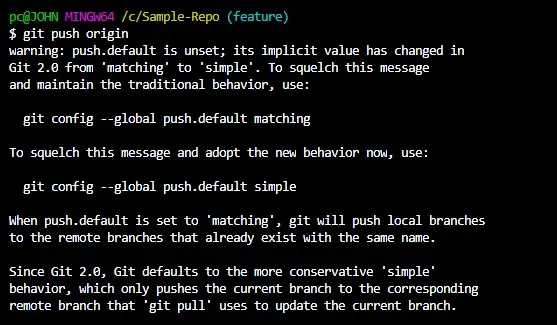
The output will be:
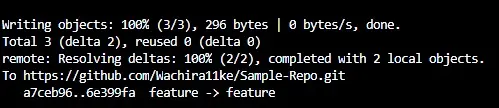
As seen from the output above, Git has used the simple configuration, which has only pushed our feature branch to the remote repository.
What happens if we set the push.default value to matching? Let’s find out.
$ git config --global push.default matching
On running the git push origin command, we will get:
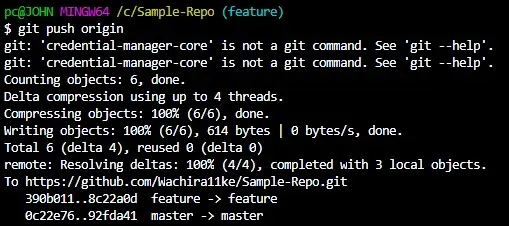
We can see that Git has pushed two branches to the remote. (i.e., master and feature branches)
In a nutshell, the git push origin master will only push the master branch to the remote tracking master branch. On the other hand, the git push origin command will push the current local branch, provided it has a remote tracking branch.
However, the behavior of this command can be changed by setting the push.default value to matching to push all local branches to their corresponding remote-tracking branches.
Summary of Differences
To summarize the differences between git push origin and git push origin master, here are the key points:
git push originpushes the current branch to the remote repository, creating a new branch if necessary.git push origin masterspecifically pushes the local master branch to the remote repository, ensuring that the primary version of the project is updated.
Understanding these differences can help you navigate Git more effectively, making it easier to collaborate with others and manage your codebase.
Conclusion
In conclusion, while both git push origin and git push origin master are essential commands in Git, they serve different purposes. The former offers flexibility by pushing the current branch, while the latter ensures that the master branch remains up-to-date with the remote repository. By mastering these commands, you can enhance your Git proficiency and streamline your development workflow. Whether you’re working solo or as part of a larger team, knowing when to use each command is crucial for effective version control.
FAQ
-
What does git push origin do?
git push origin pushes the current branch to the remote repository named “origin.” -
Can I use git push origin without specifying a branch?
Yes, if you are on a branch that is tracking a remote branch, Git will automatically push to that branch. -
What happens if I use git push origin master while on a different branch?
Git will push the local master branch to the remote repository, regardless of which branch you are currently on. -
Is it safe to use git push origin?
Yes, as long as you are aware of which branch you are pushing and that it does not overwrite important changes. -
When should I use git push origin master?
Use git push origin master when you want to ensure that the master branch on the remote is updated with your local changes.