HOWTO · R
scale_fill_continuous in R
Dieses Tutorial zeigt, wie Sie die Methode scale_fill_continuous() in R verwenden.
Die Methode scale_fill_continuous() stammt aus dem Paket ggplot2. Dieses Tutorial zeigt, wie und wo die Methode scale_fill_continuous() in R verwendet wird.
Scale Fill Continuous in R
Die scale_fill_continuous-Methode ist eine Standardfarbskala für das ggplot2-Paket, wenn die continuous auf die fill abgebildet werden. Die Syntax für diese Methode lautet:
scale_fill_continuous(..., type = getOption("ggplot2.continuous.fill"))
Die Methode verwendet options(), um Standardeinstellungen zu ermitteln. Wobei ggplot2.continuous.fill der Standardwert für die continuous Farbskala ist.
Das Argument für die Methode scale_fill_continuous kann Viridis oder gradient sein. Lassen Sie uns ein Beispiel für diese Methode ausprobieren.
Laden Sie zuerst das Paket ggplot2 und erstellen Sie einen ggplot-Graphen.
library(ggplot2)
DemoGraph <- ggplot(faithfuld, aes(waiting, eruptions, fill = density)) + geom_tile()
DemoGraph
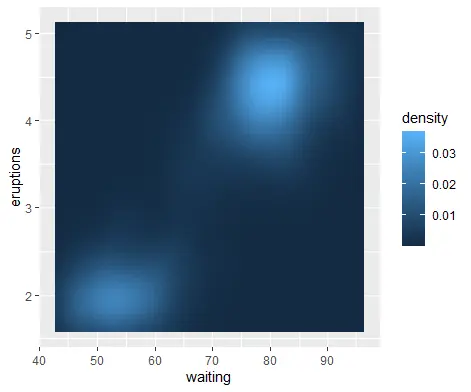
Mit der Methode scale_fill_continuous() können wir dem Graphen nun Muster geben. Siehe Beispiel:
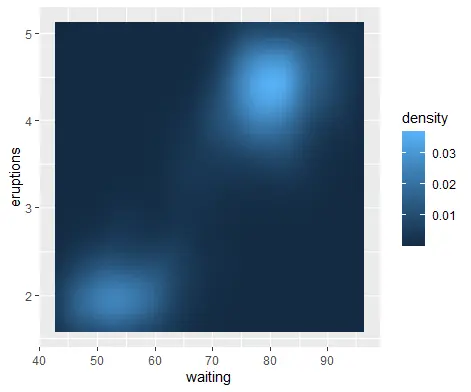
DemoGraph + scale_fill_continuous(type = "gradient")
Der obige Code gibt dem Diagramm ein Gradientenmuster. Siehe Ausgabe:
Wir können auch die Option Viridis in der Methode scale_fill_continuous verwenden.
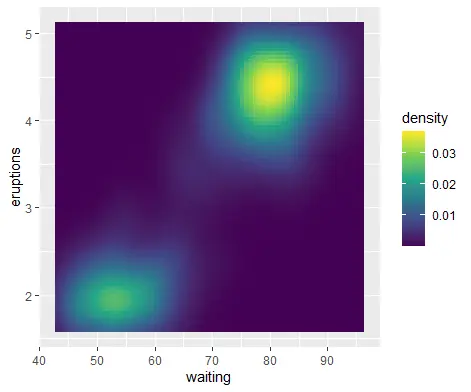
DemoGraph + scale_fill_continuous(type = "viridis")
Der obige Code ergibt das Viridis-Muster und hebt die Punkte des Diagramms hervor. Siehe Ausgabe:
Hier ist der vollständige Code der Einfachheit halber.
library(ggplot2)
DemoGraph <- ggplot(faithfuld, aes(waiting, eruptions, fill = density)) + geom_tile()

DemoGraph

DemoGraph + scale_fill_continuous(type = "gradient")

DemoGraph + scale_fill_continuous(type = "viridis")